
The Business rules in RevControl define your hotel’s internal pricing strategy.
They set the boundaries within which RevControl is allowed to calculate prices and – if applicable – publish them automatically.
These settings are independent of competitor prices and always form the foundation of RevControl’s price recommendations.
Step 1 – What are business rules?
Business rules consist of four components:
- Minimum Rates
The lowest allowed price per day. - Occupancy Supplements
Fixed surcharges that are applied when occupancy increases. - Minimum Length of Stay (MinLOS)
The minimum number of nights that must be booked. - Maximum Rates (not enabled by default)
The highest allowed price.
Together, these rules determine the occupancy-based recommended rate calculated by RevControl.
Step 2 – Why are these settings essential?
Without properly configured business rules, RevControl cannot:
- Calculate reliable price recommendations;
- Publish rates via Auto Publish;
- Apply exceptions for seasons or events.
Business rules are therefore an essential part of the onboarding process.
Step 3 – First understand the period structure
All business rules follow the same hierarchy:
- Default
Always applies, unless a period is active. - Period
Overrides the default for specific dates (e.g. a season or holiday). - Sub-period
Always overrides its parent period (e.g. an event within a season).
The most specific active period always takes priority.
Step 4 – Active vs. inactive periods (important!)
Each period and sub-period has an on/off toggle per pricing rule.
Period active (toggle on)
- Only the values entered for that period apply.
- If a field is left empty:
→ No pricing rule applies for that setting during the period.
Period inactive (toggle off)
- RevControl automatically uses the settings from the parent level
(sub-period → period → default).
Inheritance works only via the toggle, never via empty fields.
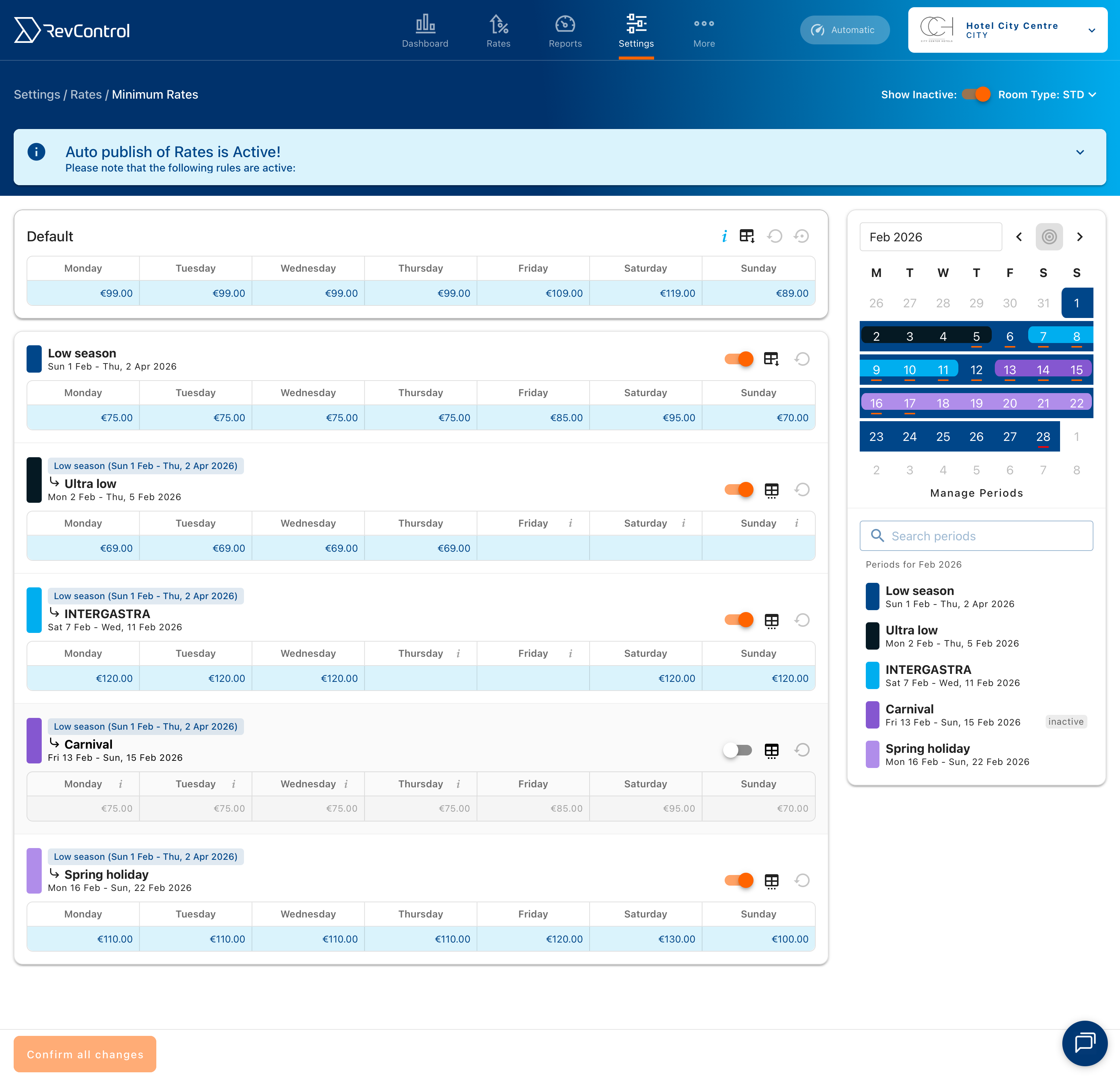
Step 5 – Setting Minimum Rates
Minimum Rates define the lower boundary of your pricing.
- Set them per room type and weekday;
- Always fill in the default;
- Activate and fill in minimum rates for all periods where they must differ from the default (or parent period);
- If a period is active but left empty → no minimum rate applies.
When Auto Publish is active, rates are never published below the minimum rate.
Step 6 – Setting Occupancy Supplements
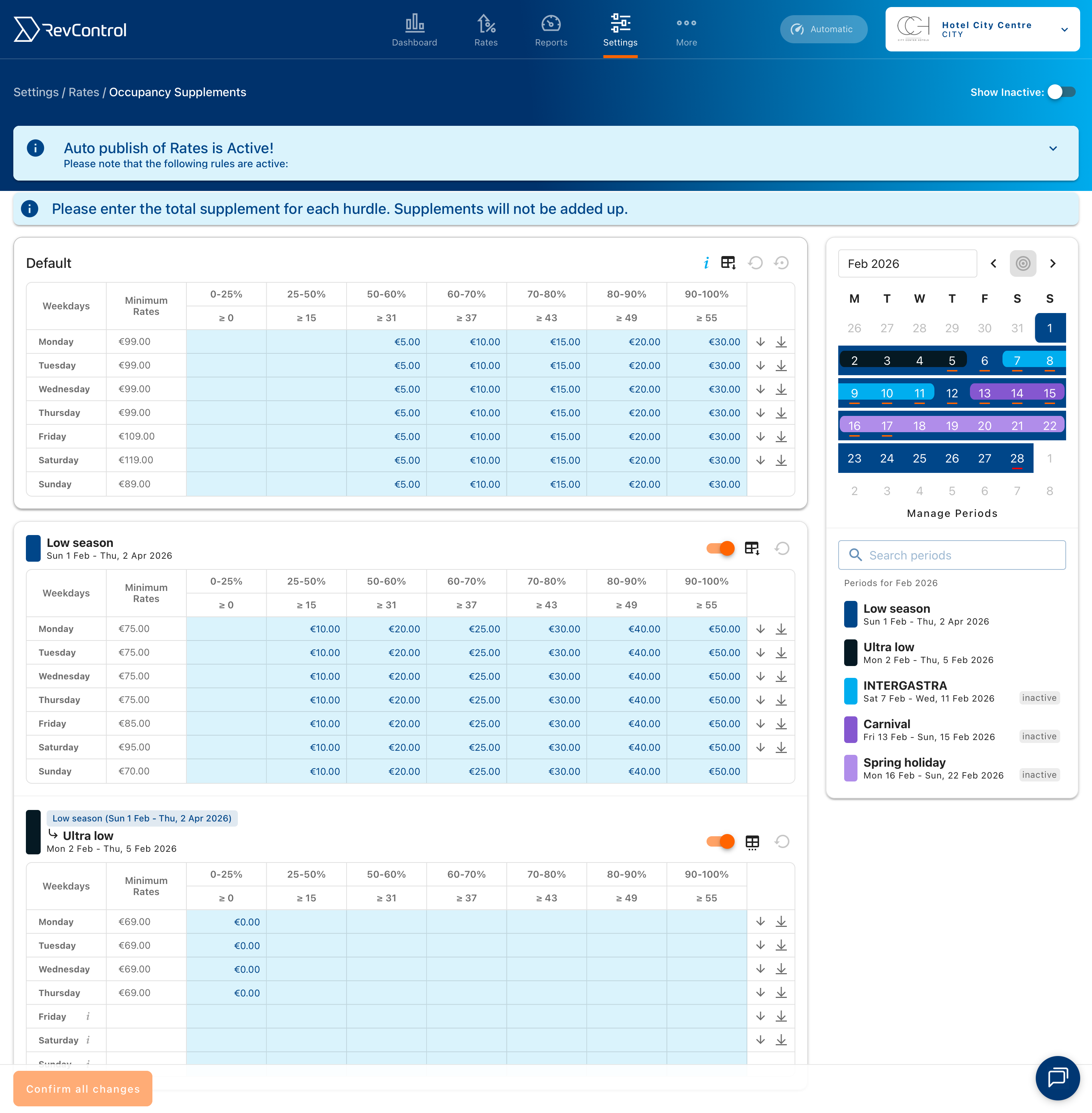
Occupancy Supplements are fixed surcharges added on top of the minimum rate.
- Applied once an occupancy threshold is exceeded;
- Based on the forecast (expected occupancy) by default;
- Optionally based on on-the-books (current occupancy);
- Not cumulative: only one supplement applies per occupancy level.
If a period is active and no supplements are filled in, no occupancy supplement applies for that period.
Occupancy thresholds themselves are configured via:
Settings → Configuration → System settings / Hotel settings → Business rules → Occupancy hurdles
Step 7 – Setting Minimum Length of Stay (MinLOS)
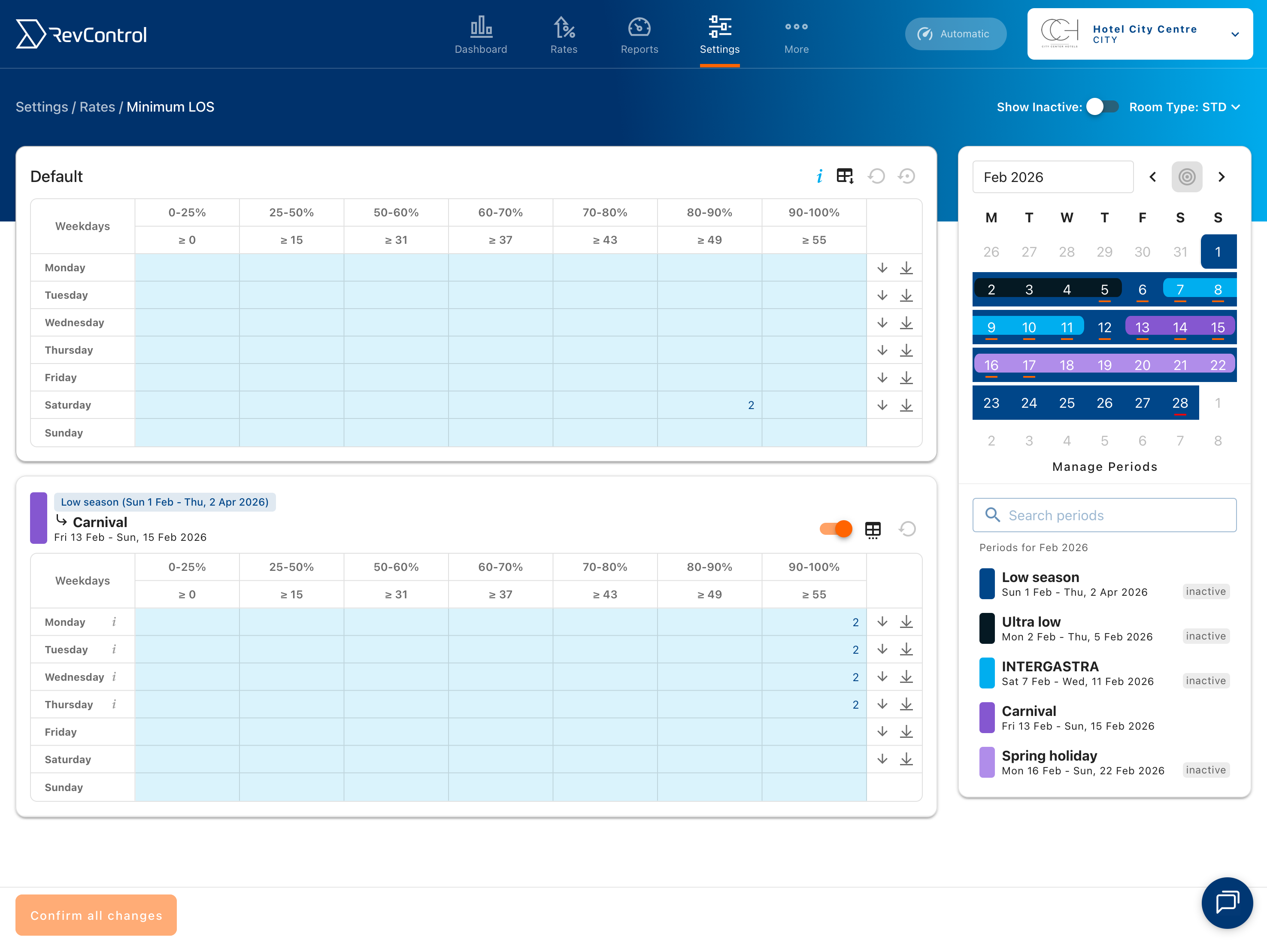
With MinLOS, you define the minimum number of nights that can be booked.
- Can be set per day, period, or occupancy level;
- Based on the forecast by default, optionally on on-the-books;
- Can automatically increase as occupancy rises;
- If a field is left empty, the value from the previous (lower) occupancy step is used.
If a period is active and MinLOS is left empty, no minimum length of stay applies for that period.
Step 8 – Setting Maximum Rates
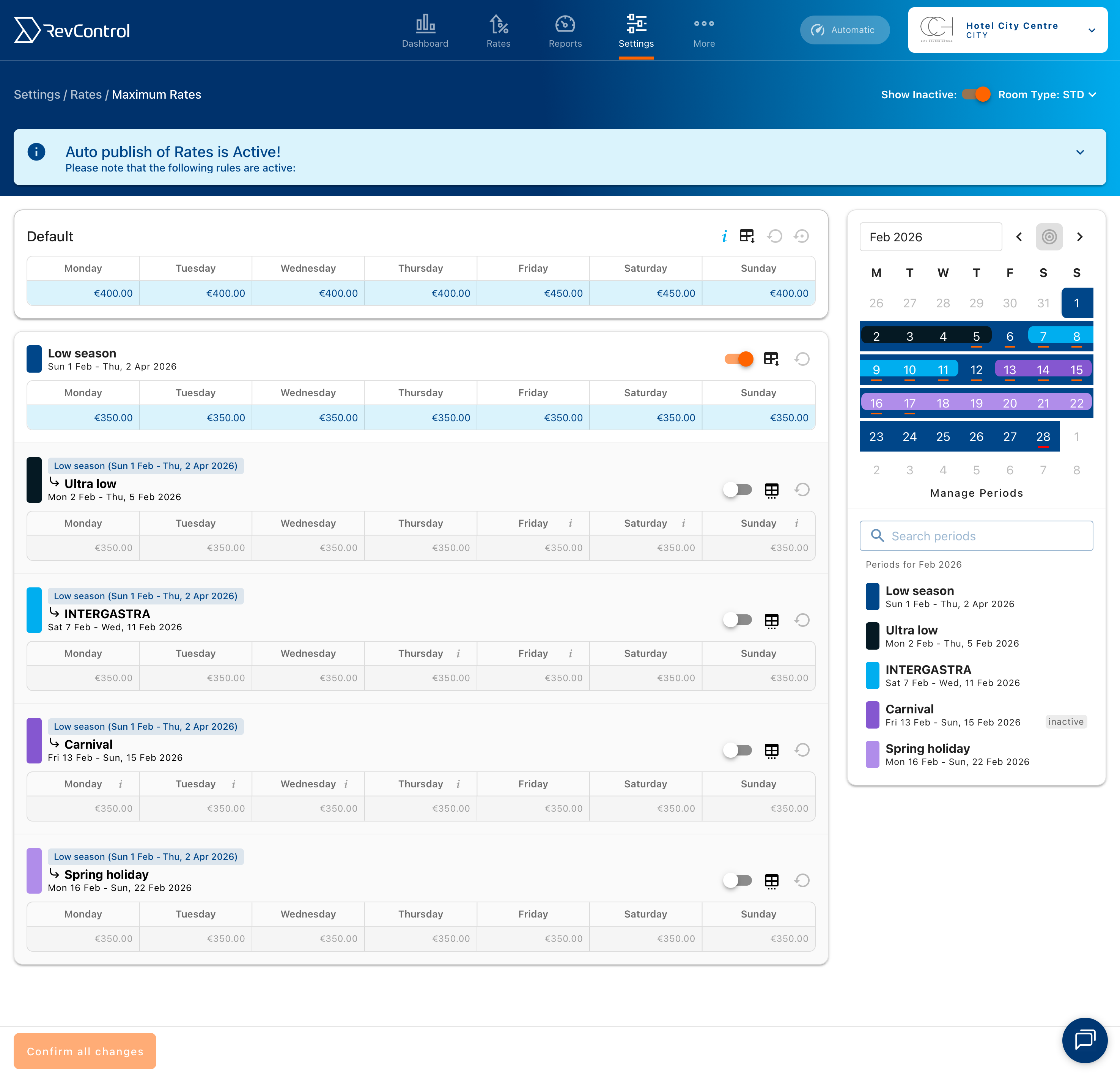
Maximum Rates define the upper boundary of your pricing.
- Not enabled by default;
- Activation is handled by the Customer Success team;
- With Auto Publish enabled, rates are never published above the maximum;
- Manually setting higher rates is possible, but triggers a warning.
Step 9 – Final check before going live
Always check:
- Are all defaults filled in?
- Are periods intentionally set active or inactive?
- Are active periods actually filled in?
- Does the period structure match your pricing strategy?
Notifications such as Missing business rules always indicate an active but empty setting, or a missing default. Also make sure to check all room types, if applicable.
Summary
- Businessrules define your internal pricing strategy
- They work with defaults, periods, and sub-periods
- Inheritance only works via the toggle
- Active period + empty field = no pricing rule
- Correct setup is essential for RevControl